 Study Architecture
  ProPEL
 AALA Column, January 2026
Association of Architecture Librarians and Archivists (AALA)

Association of Architecture Librarians and Archivists (AALA)
Column by Maya Gervits, Director of the Littman Architecture Library, New Jersey Institute of Technology
An article published in the November 13 issue of Psychology Today notes that, in the age of artificial intelligence, the future increasingly belongs to those who can “synthesize across domains, navigate ambiguity, and make meaning within complex systems.” Success now relies on the ability to think broadly, connect ideas creatively, and move seamlessly across disciplines. At the heart of these skills is collaboration.
For design disciplines, and architecture in particular, collaboration is not optional but fundamental. Its roots extend from medieval guild traditions to modern academic models. Collaboration lay at the heart of the Bauhaus and Vkhutemas and was foundational to institutions such as Black Mountain College and the Ulm School of Design. In today’s academic environment, architecture students are educated through team-based studios, collective modes of production, and iterative critique. As a result, they expect their institutions, and libraries in particular, to model the same collaborative practices that are central to their academic training and future professional work.
Collaboration between faculty and librarians is therefore essential and goes far beyond traditional collection management, although stewardship of collections remains a vital part. Through ongoing partnerships with faculty, architecture librarians support studio-based teaching, design research, promotion and tenure processes, community building, preservation of institutional memory, recruitment, and accreditation. These collaborations improve student learning, support faculty work, and help preserve the cultural and intellectual legacy of architectural programs.
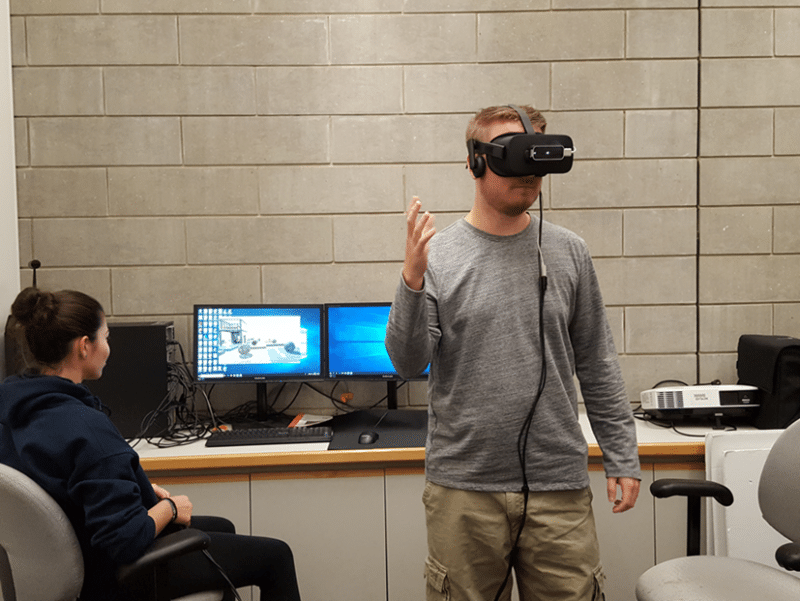
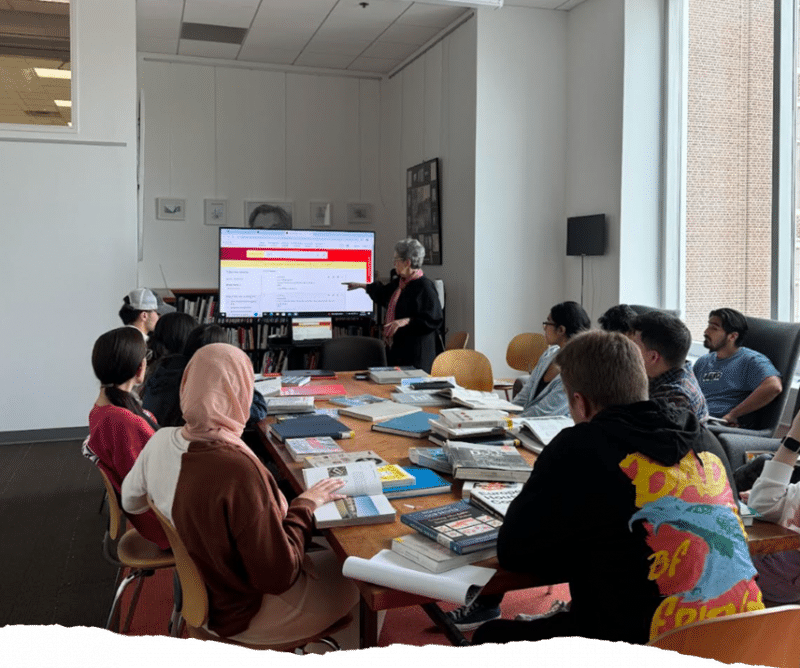
We view the Littman Library as:
Both a physical and a digital interface. People-centered place to create knowledge, learn, teach, and get inspired, foster curiosity, and creativity. The library serves as an extension of a classroom, a place for collaborative learning, and a center for community activities. It offers both direct access and mediation by librarians who are subject specialists.
It is a flexible space with multiple zones and movable furniture, that can be used for different events and work on various projects.
Internal and external collaboration to support the institutional mission and goals is the key to success.
Fig. 1: Littman Architecture Library, New Jersey Institute of Technology. Images of students utilizing immersive virtual reality technology and participating in group collaborations.
Through direct collaboration in design studios, librarians provide instruction and subject consultations in precedent analysis, standards, visual literacy, and research methodologies, among other topics. They create instructional materials embedded within learning management systems and develop tutorials and research guides that support the curriculum and offer continuous, on-demand access to digital resources. This integrated approach allows faculty to focus more fully on teaching core design skills while ensuring that students develop research skills embedded in the design process.
Librarians assist faculty in navigating architectural scholarships, which are often dispersed and available in various formats such as books, journals, exhibitions, digital platforms, and professional practice outputs. Their role becomes especially vital during promotion and tenure reviews, as citation analysis in architecture cannot be reduced to simple numerical metrics. By providing narrative context and clarifying the limitations of traditional metrics, librarians help ensure a fair and informed evaluation of design-based and public-facing scholarship. Faculty–librarian collaboration also influences collections to reflect better shared disciplinary values and teaching priorities rather than individual preferences. Collectively developed collections not only support research and teaching but also enhance accreditation processes and program reviews while maintaining historical continuity.
As architectural practice increasingly incorporates digital technologies, libraries can serve as experimental labs, testing grounds, platforms, and resources before these tools become part of the curriculum. This transforms the library into a space for innovation and pedagogical exploration. Libraries provide access to specialized software and infrastructure, including Rhino, Revit, GIS, high-performance computing, 3D printing, virtual and augmented reality, digitization stations, cameras, scanners, and audiovisual equipment. Recently, emerging platforms such as VirtualSpeech, which integrates VR, allow AI-supported feedback to improve presentation and communication skills.
Architectural knowledge is generated not only through texts but also through visual materials and physical artifacts. Libraries and faculty work together in creating and maintaining image databases, digital archives, and collections of material samples that support teaching, research, and design experimentation. They collaborate on the development of open educational resources (OER) and co-curate various displays and exhibitions, positioning the library as a site of architectural authorship and public engagement, thereby expanding collaboration into the institutional and public realms.
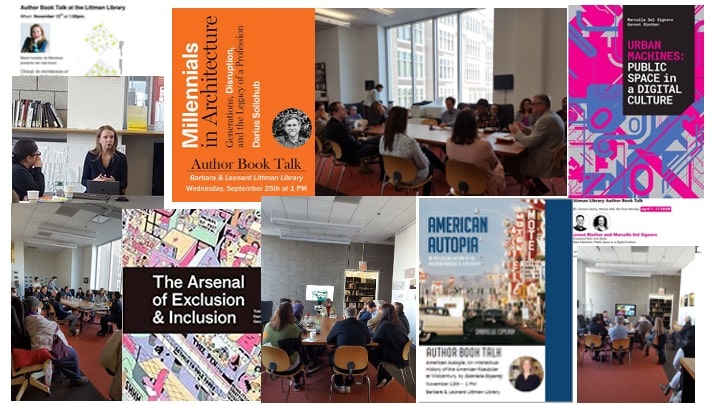
Fig. 2: Collection of author book talks held in the Littman Library.
Library-hosted events, ranging from faculty book talks, music concerts, colloquia, skills exchange programs, and other events enhance scholarship, enrich student learning, broaden horizons, raise the library’s academic profile, and strengthen institutional culture. They showcase faculty research, encourage discussion and collaboration among peers and students, and transform libraries into spaces for intellectual exchange. Meetings with alumni help to strengthen the educational ecosystem by connecting students and faculty to professional practice, mentoring networks, and evolving disciplinary knowledge.
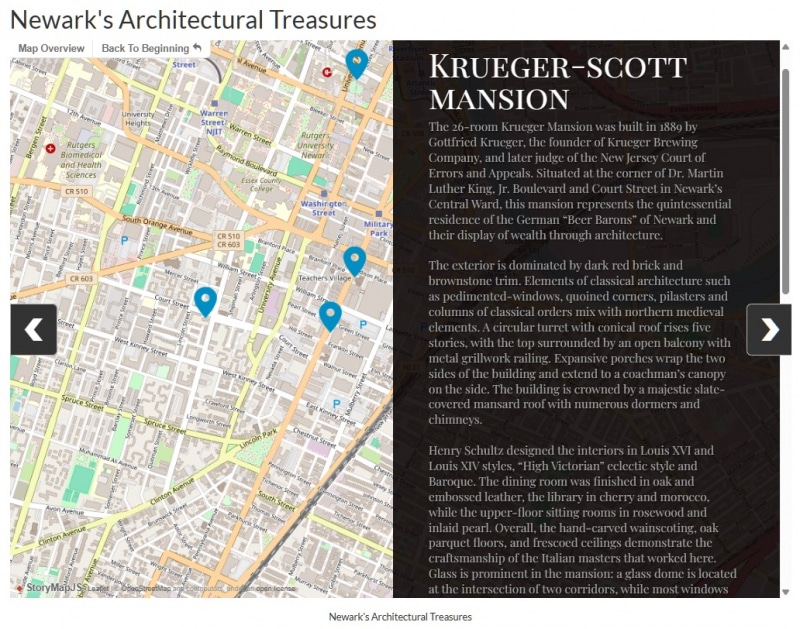
Fig. 3: The DANA project is an initiative by the New Jersey Institute of Technology to document the built environment of Newark, New Jersey. https://dana-legacy.njit.edu/
Libraries also play an essential role in preserving institutional memory by collecting, organizing, and providing access to materials in multiple formats, both physical and digital. While documenting curricular development and institutional history, this work also supports accreditation requirements.
In recruiting both faculty and students, librarians highlight the often-invisible infrastructure that supports architectural education: research collections, visual resources, technological innovation, and archival continuity. These assets are crucial for attracting and maintaining a vibrant academic community, transforming the library into a hub for creativity and connection.
Recognizing architectural librarians as strategic partners, rather than peripheral service providers, fosters academic and professional success and builds a strong sense of community in an increasingly complex educational landscape.
As the Powerful Partnerships report reminds us: “Only when everyone on campus shares responsibility for learning will we make significant progress.” The future of libraries lies in building communities where knowledge is created, shared, and celebrated.
Founded in 1912 by 10 charter members, ACSA is an international association of architecture schools preparing future architects, designers, and change agents. Our membership includes all of the accredited professional degree programs in the United States and Canada, as well as international schools and 2- and 4-year programs. Together ACSA schools represent some 7,000 faculty educating more than 40,000 students.
Enter your name and email below, and we’ll send you the latest ACSA news and events.
© Copyright 2026 ACSA


